

Ryan’s Sunday Night Leadership Lessons 🔑 #17 – October 15, 2023
Do meetings feel like a waste of time? Well, a big reason they often feel wasted and unproductive is due to not setting a proper agenda ahead of the meeting. In this post, I’ll explore the critical role of setting an agenda in meetings, and how it can help you maximize time management and work efficiently. Here are three key points to consider:
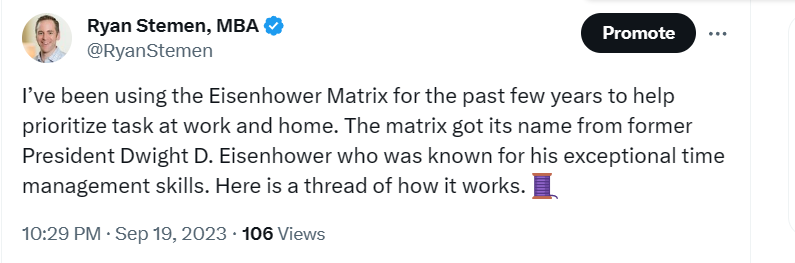
1. Focus your agenda with The Eisenhower Method.
One of the most effective tools for time management and prioritization is using the Eisenhower Method. This method categorizes tasks into four quadrants based on their urgency and importance. By setting a clear agenda for your meeting, you are essentially applying the principles of the Eisenhower Method to the meeting itself. Below are four ways to divide up agenda points by incorporating the Eisenhower Method:
Important and Urgent: These are the top-priority issues that need immediate attention. By including such items in your agenda, you ensure they receive the focus they deserve during the meeting.
Important but Not Urgent: Items falling in this category are often strategic, long-term, and impactful. An agenda allows you to allocate time for these important discussions without getting lost in the minutiae of day-to-day tasks.
Urgent but Not Important: Sometimes, there are tasks that are urgent but not necessarily critical. By having a well-defined agenda, you can minimize time spent on these items or postpone them to a more suitable time.
Not Urgent and Not Important: These are tasks that should be avoided or delegated. An agenda helps filter out such topics, ensuring your meeting remains focused on what truly matters.
2. Use Effective Communication to Promote Participation.
An agenda acts as a roadmap for the meeting, guiding participants through the discussion points. Agendas help attendees prepare in advance, so they can contribute meaningfully and effectively during meetings. This, in turn, ensures that the meeting is not just a one-way communication but a collaborative effort to address important matters.
To maximize the efficiency of your meetings, encourage participants to review the agenda before the meeting. This fosters better understanding of points, sharpens insights, and can lead to a higher level of engagement. When everyone comes to the meeting prepared, discussions become more productive, and decisions are made efficiently. This in turn helps to save everyone’s precious time.
3. Time Management Leads to Efficiency and Productivity.
Perhaps the most crucial aspect of setting an agenda in meetings is the efficient use of time. By defining the topics to be discussed and assigning time slots to each, you create a sense of structure and discipline. This prevents the meeting from meandering into unrelated or time-consuming discussions.
The agenda also serves as a time clock for everyone in the meeting, thus ensuring that each topic receives the attention it deserves without overextending the meeting’s duration. This approach respects the valuable time of all participants, making them more likely to view meetings as productive and worth their time.
In conclusion, setting a clear agenda is a fundamental step in transforming your meetings from time-wasting events into productive sessions for everyone involved. By incorporating principles like the Eisenhower Method and promoting effective communication, you can maximize your time management, work efficiently, and make the most of your valuable meeting time. Start setting agendas for your meetings today to watch your productivity soar.
#Timemanagement #Leadership #Meetings #Agendas
 Ryan Stemen, MBA